Kongsberg Type 1
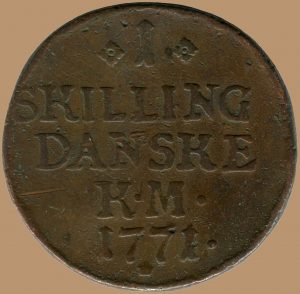
The Kongsberg mintage of the 1 skilling 1771 began in late 1782, more than 11 years after the first 1771 skilling coins were struck at the Altona Mint. The production plan was quite ambitious, with a target of 1,920,000 coins (20,000 Rigsdaler). Although the first 23,184 coins were delivered in April 1783, production soon came to a halt because of poor copper quality.
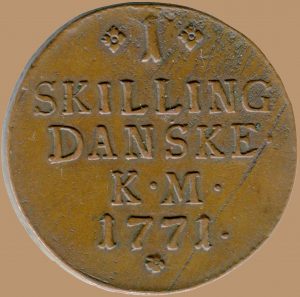
We believe Kongsberg Type 1 was minted during this early period. It was a small production series consisting of only two reverse dies, K101 and K102, together with their corresponding obverses. The dies were made by Anders Lunde and have a characteristic font that differs considerably from those used by Johan Ephraim Bauert at the Copenhagen Mint and Johan Henrik Wolff at the Altona Mint.
Although K101 is uncommon, the relatively large number of known K102 coins suggests that this variation may also have been used when mintage resumed during the second half of 1784. At least the corresponding obverse dies of K101 and K102 were used during this period in combination with Kongsberg Type 2 reverse dies.

Kongsberg Type 2
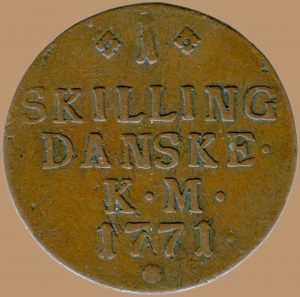
Lunde was probably quickly instructed to adjust his fonts to resemble those used for the Altona and Copenhagen mintage more closely. We believe he made the Kongsberg Type 2a dies during the summer of 1784, when the Mint was preparing to increase production substantially. Copper platelets had arrived from Sweden, allowing production to resume. Type 2a consists of 14 pairs of dies that were used during the second half of 1784.
The copper used at the Kongsberg Mint was notoriously impure throughout the mintage period. After the first 194,880 Type 2a coins had been minted, the Kongsberg Mint received 240,000 blank copper planchets from Copenhagen in August 1784. These planchets were made from copper of a more conventional quality and were immediately used for the production of Kongsberg Types 2b and 2c. Because these planchets were larger than the standard Kongsberg 1 skilling planchets, the dies had to be adjusted to accommodate the larger diameter.
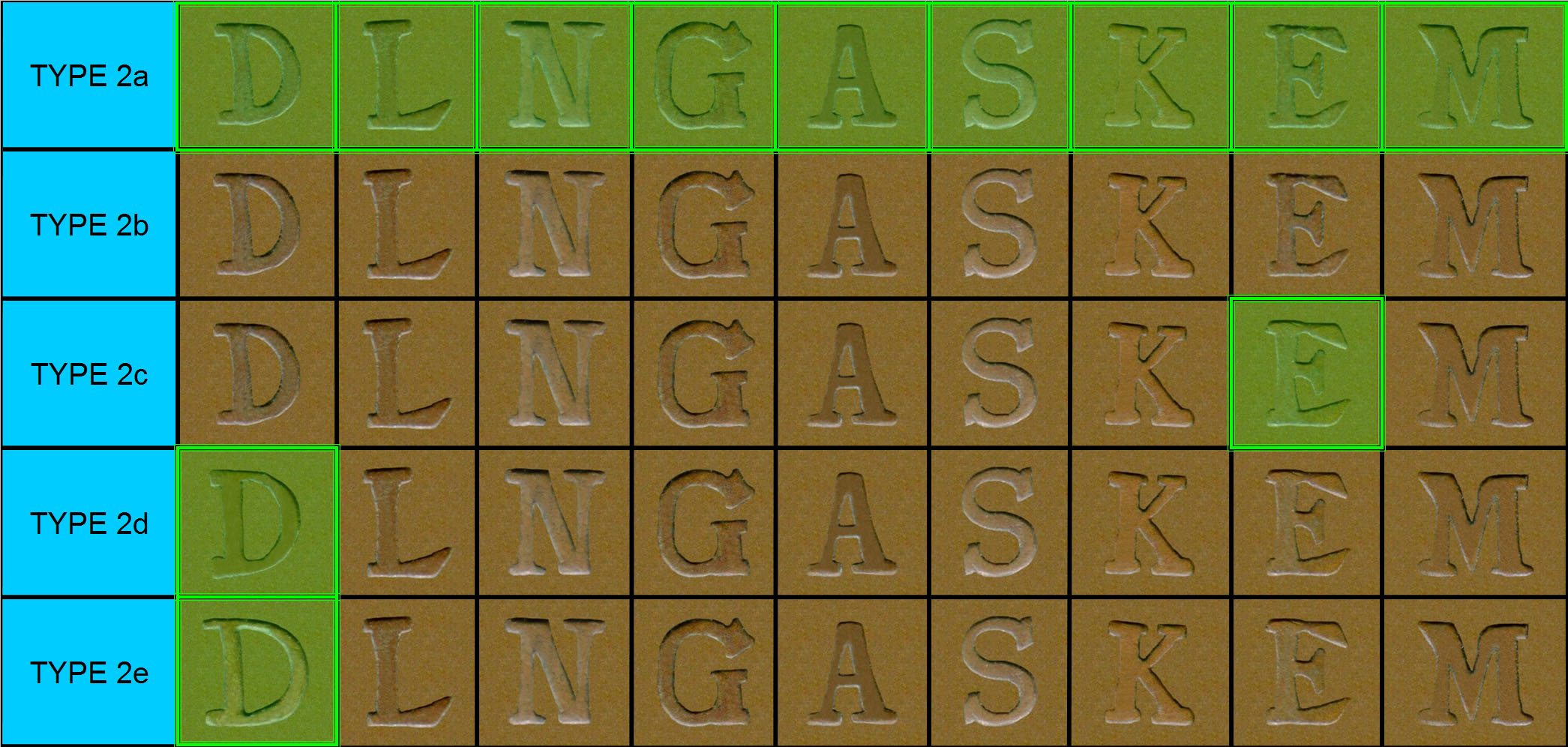
The only difference between Types 2a and 2b is the size of the coin, as the fonts are identical. Kongsberg Type 2b consists of two reverse dies, K231 and K232. From Type 2b, we can see a development into Type 2c, where the lower stroke of the “E” rises more evenly from the vertical stem. The six Type 2c reverse dies were also made specifically for the larger copper planchets, and there are numerous die pairings between Types 2b and 2c.
After the copper planchets had been used up, the Kongsberg Mint reverted to Type 2a dies in late October 1784. At this point, it probably still had eight to ten pairs in storage. Lunde also continued producing new dies of the normal size. However, he made a small change to the “D”, making it somewhat larger; these dies are classified as Kongsberg Type 2d. There appears to have been no preference for using older dies rather than newer ones, resulting in numerous die pairings between Types 2a and 2d. Later, probably in December 1784, this development continued with an even larger “D” in Kongsberg Type 2e.
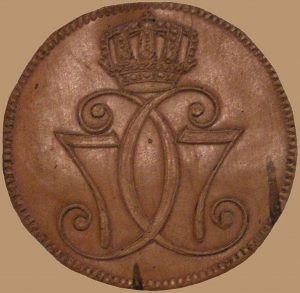
It should be noted that Lunde was probably not the only die cutter involved in the Kongsberg Type 2 mintage. In June 1783, Nicolai Wilhelm Wright joined the Kongsberg Mint as Lunde’s apprentice and quickly made progress in the art of die cutting. During the summer of 1784, he appears to have impressed his superiors at the Danish Treasury Administration with his test dies and was encouraged to continue assisting Lunde. A test die made by Wright during this period (see picture below) shows strong similarities to the obverses KO221, KO263, KO268 and KO269, which were made in very late 1784 or early 1785. Wright's test die has additional “stems” or “waves” above the circlet at the base of the crown. We assume that he also made some of the reverse dies, but we currently have no evidence that allows us to distinguish them from Lunde's work.
While production of Kongsberg Type 2 was intense in late 1784, with approximately 100,000 coins minted each week, the pace slowed considerably into 1785. In fact, production practically came to a halt, with only 40,000 coins delivered by August 1785. Altogether, 36 pairs of dies were made for the Kongsberg Type 2 mintage.
Kongsberg Type 3
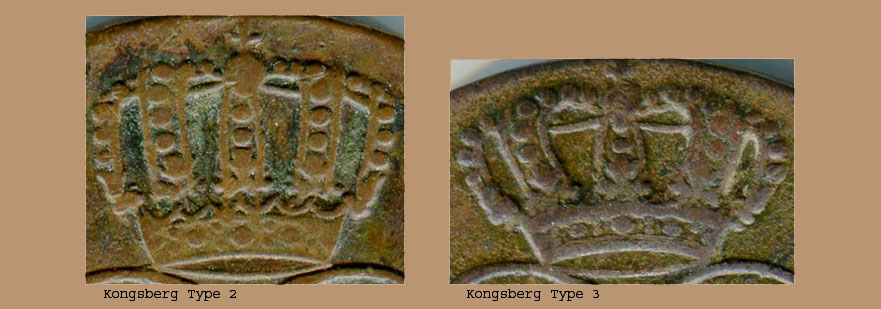
For a change, it is the obverses that distinguish Type 3 from the other Kongsberg variations. The reason for the change was most likely a poorly executed Rigsdaler Species for which Anders Lunde was harshly criticized by the Treasury Administration. They even sent him a lead imprint from a die made by an apprentice in Copenhagen (Georg Valentin Bauert) to show him how to do his job. As can be seen in the picture below, the crown was altered to make it flatter and broader, in line with Bauert's example.
On the reverse, we see a development towards a slimmer “S” (marked in green below). Close to 800,000 Kongsberg Type 3 coins were minted during the autumn and winter of 1785–1786. Most were delivered before the end of 1785, while the final 80,000 coins were delivered in June and October 1786. Altogether, 16 pairs of dies were made for the Kongsberg Type 3 mintage.
